A Reflection on the UN Convention on the Rights of Persons with Disabilities (UNCRPD) and its impact on Western Australians with Intellectual Disabilities with reputations for behaviours of concern
The Convention on the Rights of Persons with Disabilities was adopted in December 2006 and ratified by the Australian government in 2008. In 2007 the West Australian disability sector published a report titled’ The WA Sector Health Check’ which concluded that ‘challenging behaviour is a human rights and quality of life issue for individuals, primary carers and families’.
As a direct consequence of the recommendations contained in the WA health check a framework was developed that dramatically changed how services to support West Australians with behaviours of concern were provided. The framework led the way to how services were developed and provided through the National Disability Insurance Scheme as applied in Western Australia.
Use of restrictive practices is at odds with international human rights obligations for the treatment of people with disability. There is an absolute non-derogable prohibition on torture and cruel, inhuman or degrading treatment or punishment under international law. This means that restrictive practices that rise to the level of torture and cruel, inhuman or degrading treatment or punishment must be prohibited. Further, there are strong human rights obligations relating to prohibition of discrimination against people with disability and rights to protection from violence. In so far as restrictive practices represent a form of violence that is applied on a discriminatory basis to people with disability, then these practices, even where they do not rise to the level of torture and cruel, inhuman or degrading treatment or punishment, are at odds with international law.
The principle of dignity is at the core of international human rights obligations to prevent torture and ill-treatment, protections from violence, and equality and non-discrimination. Use of restrictive practices fails to respect the inherent dignity of people with disability.
PBS is an evidence-based, values-driven approach that rejects aversive techniques and focuses on prevention, skill-building, and environmental changes.
It emphasizes improving quality of life, autonomy, social inclusion, and personal competence for individuals.
PBS is holistic, addressing the ecological and social contexts that contribute to challenging behaviours, rather than focusing solely on the behaviours themselves.
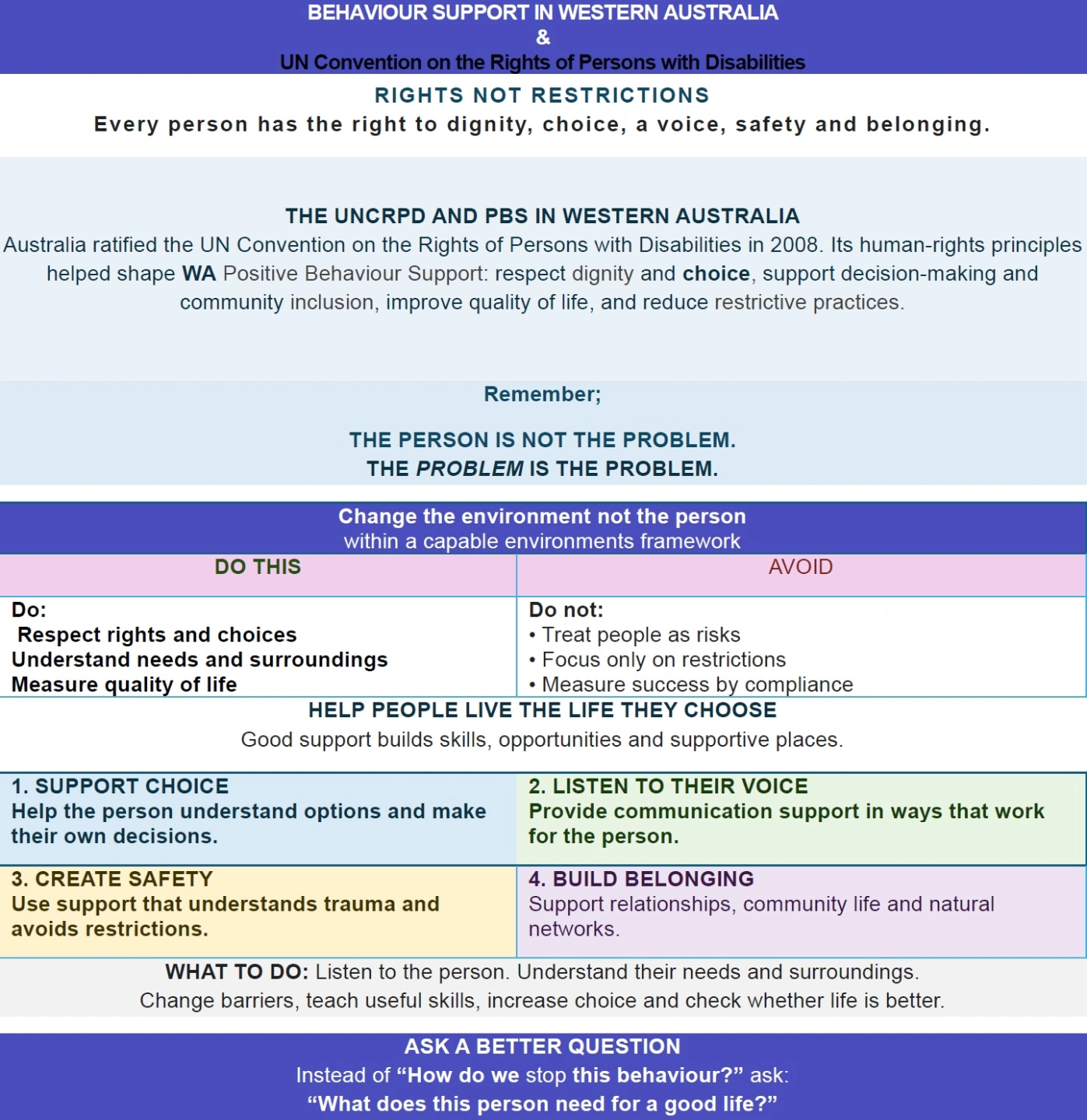
‘The person is not the problem- the problem is the problem’
Partnerships with individuals, families, and support networks are central, promoting self-determination and reducing power imbalances between professionals and people with disabilities.
PBS aligns with CRPD principles by promoting dignity, autonomy, inclusion, and the right to effective, non-restrictive treatment.
Practitioners must ensure interventions uphold human rights and avoid practices that perpetuate rights violations, based on a legal and ethical framework as presented in CRPD.
However, Positive Behaviour Support (PBS) in Australia has become too focused on managing risk and complying with restrictive-practice regulations, rather than helping people with disability achieve meaningful, self-directed lives. Therefore there needs to be a more human rights-based, "constructional" approach to PBS.
The current disability support system is often better at documenting restrictions than building opportunities, choice, participation, and quality of life for people with disability. PBS should focus on creating the conditions for people to flourish rather than simply reducing behaviours of concern.
The UNCRPD requires more than preventing harm. It requires supporting people to:
Exercise legal capacity and make their own decisions
Live independently
Participate fully in communities
Experience choice, autonomy, and belonging
Current NDIS regulation focuses heavily on:
Authorising restrictive practices
Monitoring risk
Reporting incidents
Compliance processes
This can unintentionally position people as subjects of risk management rather than holders of rights.
A rights-based PBS approach asks: "What does this person need to live a meaningful life?"
Australian PBS has drifted from its original purpose. The proposed solution is a constructional approach, which focuses on:
• Expanding opportunities
• Building supportive environments
• Increasing choice and self-determination
• Reducing reliance on restrictive practices
• Measuring quality-of-life outcomes
• Aligning practice with human rights principles
• The British Institute of Learning Disabilities (BILD) concludes- Behaviors that challenge are understood as arising from interactions among biological, psychological, and social factors rather than being solely a feature of the individual.
Evidence from the Australian Royal Commission into Violence, Abuse, Neglect and Exploitation of People with Disability;
People with intellectual disability, especially those with complex needs, are most likely to experience restrictive practices, particularly in group homes and detention settings.
Lack of autonomy and choice in segregated settings increases the use of restrictive practices.
Changing Understanding of 'Behaviours of Concern'
Behaviours often labelled as 'challenging' are increasingly recognized as expressions of unmet needs or responses to difficult environments, not simply problems to be managed.
The focus must be on shifting from pathologizing individuals to understanding the context and drivers of behaviour.
Holistic Model for Elimination The Royal Commission report identifies four essential factors for reducing and eliminating restrictive practices:
Supported Decision-Making: Ensuring people with disability have the support to make and have their own decisions recognized, replacing substituted decision-making systems.
Early Access to Communication Support: Moving from a restrictive 'candidacy' model to a strengths-based 'participation' model, ensuring all individuals have access to communication support throughout life.
A Trauma-Informed Lens: Recognizing the prevalence and impact of trauma, adopting practices that are sensitive to trauma histories, and focusing on strengths and safety.
Belonging in Ordinary Community Life: Promoting inclusion, community belonging, and natural support networks as protective factors against violence, abuse, and restrictive practices.
Enabling Environments Framework
The core principles of an enabling environment aim to; support wellbeing, reduce distress, and improve quality of life for people with learning disabilities.
It emphasises positive relationships, communication support, meaningful activity, predictable routines, skilled carers, and organisational structures that enable people to thrive.
Evidence for PBS is generally positive, especially when delivered through specialist services and high-quality support systems. However, the report notes that short training courses alone often do not produce strong outcomes, and more rigorous research is still needed.
• In Western Australia, there has been a significant increase in the number of registered PBS practitioners since the start of the NDIS. Whilst this has been positive for Western Australian NDIS participants with behaviours of concern, the quantity of practitioners may not always equate to the quality of the outcomes for NDIS participants. There remains a risk, as noted by many authors, that PBS may focus on the documentation and justification for the use of restrictive practices rather than on improving quality of life for an individual.
• Graduate Certificates in Positive Behaviour Support and Complex Communication Needs from Curtin University in WA provides a values based learning experience and supports dedicated practitioners to deepen their knowledge and skills in positive behaviour support and assist West Australians with reputations for behaviours of concern.
• The ultimate hope is that Positive Behaviour Support in WA maintains the original vision articulated in the UN Convention on the Rights of Persons with Disabilities
This is a heading
References:
The Western Australian Positive Behaviour Support Framework 2008
2009 WA document- Responsive Services for all
Erin S. Leif, (2026) Positive Behaviour Support and the Pursuit of Human Rights ()
D Kincaid (2018) Staying true to our PBS roots. (Journal of Positive Behavior Interventions Vol. 20(1) 15– 18)
A positive behaviour support practice framework for disability and community services in Australia that prioritises human rights and evidence-based practices, (Disability and Rehabilitation, DOI: 10.1080/09638288.2024.2402079)
Dr J Chan (2016) Challenges to Realising the UCCRPD in Australia for people with ID and BoC. Psychiatry, Psychology and Law, 23:2, 207-214, DOI:
Chan, J, French ,P , Webber, L (2011) PBS and the UNCRPD. International journal of PBS, 1,1,7-13
Bild, International Journal of Positive Behavioural Support, 12, Supplement 1,( 2022)
Research Report on RP from the Royal Commission into Violence, Abuse, Neglect and Exploitation of people with disabilities (2023)
Jorgensen M et al (2023) Environments of concern’: reframing challenging behaviour within a human rights approach
International Journal of Developmental Disabilities 2023 VOL. 69
Fisher, A., Louise, K., Reschke, K., Kremer, P. & Kelly, G. (2024) Positive behaviour support under the National Disability Insurance Scheme in Australia: Barriers, enablers and support needs from the perspective of practitioners
Australian Journal of Social Issues, 59, 1031–1049.